
Chicago is a city resplendent with renowned architecture, amazing museums, fabulous art, lovely parks, great food, neat history, and fine culture. During the Industrial Revolution, Chicago’s access to shipping and railroad routes gave it a prime location to be part of the nation’s growing industrial output. The city was rebuilt in a modern fashion after the Great Fire of 1871, laying the blueprint for some of the buildings one can see today. Chicago earned the moniker “Second City” and great acclaim when it hosted the 1893 World’s Fair. The city showed off its riches, culture, and the architectural genius of Burnham & Root during that exposition—the remnants of which are still around. I love wandering the streets of Chicago and exploring its past and present. If you want to experience some of the best that Chicago has to offer while saving money, I recommend CityPASS®️ Chicago.
What is CityPASS®️?
CityPASS®️ is a ticket that allows you access to some of the major attractions of a city at a discounted price. CityPASS®️ is available in many North American cities, such as Boston, Chicago, Atlanta, Philadelphia, New York, and Orlando—to name a few. With the Chicago CityPASS®️, you get one-time admission to five attractions at a discounted price.
What Sites Can You See with CityPASS®️ Chicago?
Chicago’s CityPASS®️ gives admission to:
- Shedd Aquarium
- Skydeck Chicago
Additionally, you can pick three more attractions of your choice from the following list:
- Shoreline Sightseeing Architecture River Tour
- Field Museum
- 360 Chicago Observation Deck
- Griffin Museum of Science and Industry
- Art Institute of Chicago
- Adler Planetarium
What did we see with our CityPASS®️?
I enjoy that the CityPASS®️ has two fixed attractions, since narrowing down what to do in any given city is always a little difficult for me. So much to see! Shedd Aquarium and Skydeck Chicago are a set part of the pass, so I only had to choose three more. In the end I chose to see the dinosaurs (my favorite) at the Field Museum, view some Impressionist art at the Chicago Art Institute, and compare skyscrapers by going to the 360 Chicago Observation Deck. Had the weather been warmer (it was January), I probably would have selected the river tour, but it was far too chilly for that while we were there.
Shedd Aquarium
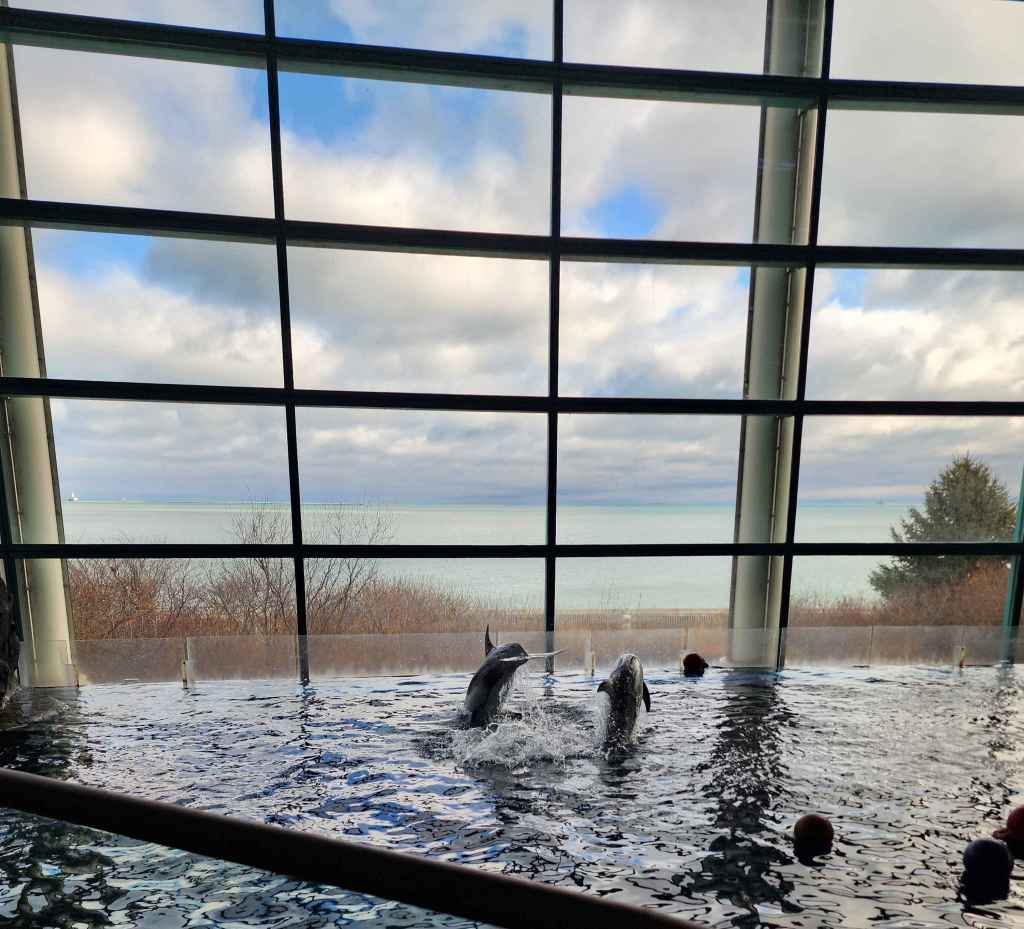
Near Soldier Field and the Field Museum in Chicago’s Museum Campus, with sweeping views of Lake Michigan, is Shedd Aquarium—one of the city’s most beloved cultural landmarks and a must-visit for curious travelers of all ages. Opened in 1930, thanks to the generosity of retail magnate John G. Shedd, the aquarium was designed to bring the wonders of the world’s waters to the Midwest, and it still does so with remarkable flair. Visitors encounter everything from playful dolphins and graceful beluga whales to vibrant coral reefs and fierce-looking sharks. They host many immersive exhibits—I touched a starfish (and tried to touch a sturgeon) and have several shows and talks where the trainers work with the animals in a neat amphitheater. Blending nearly a century of aquatic history with science and conservation, the Shedd Aquarium offers a joyful experience (I couldn’t stop smiling) that reminds you how fascinating our planet’s water systems truly are.
Accessibility thoughts:
I was very impressed with the thoughtful way that Shedd Aquarium has considered the needs of mobility-challenged people. In many theaters, wheelchair/mobility scooter seating is at the top. I’ve watched from the very back of a theater, squinting to see, with Jon far too many times. At Shedd Aquarium, they have designated wheelchair seating in the first row. Those who are mobility challenged will be able to see the dolphins and beluga whales play with ease. I found the layout to also be very intuitive for wheelchair users with easy, clear paths and ample elevators.
Skydeck Chicago
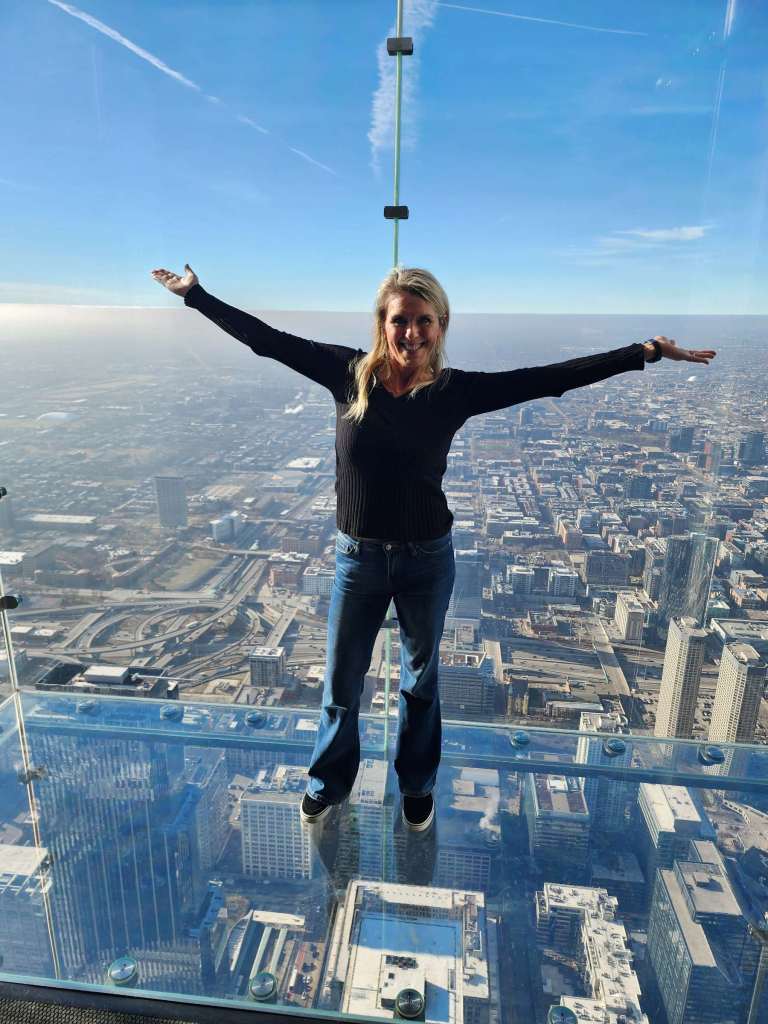
Soaring 1,353 feet above downtown Chicago, Skydeck Chicago delivers one of the most thrilling views in the United States from the top of the iconic Sears Tower, now known as Willis Tower. Completed in 1973 as the headquarters for Sears, Roebuck & Co., the building was once the tallest in the world and quickly became a powerful symbol of Chicago’s architectural ambition and engineering prowess. When you enter, you can either use the expedited entry that you get with the pass or go through the museum they have. I chose the museum and was happy I did so. The exhibits told the history of the tower and the city, giving fun photo ops with recreations of city landmarks and cultural icons (want to pose with deep dish pizza, anyone?). Then, visitors ride high-speed elevators to the 103rd floor, where floor-to-ceiling windows reveal sweeping views across the city and Lake Michigan. The experience is made even cooler with The Ledge, a series of glass boxes that extend out from the building, allowing guests to quite literally step out over the city below. I’m not scared of heights, but even I felt my stomach turn a little when I stepped out of there. It didn’t help that there was a piece of glass exhibited on the wall showing that only the glass I would stand on is only 1.5 inches thick. Eek! Jon wouldn’t even try to step out, choosing to take my photo instead. Skydeck Chicago was an unforgettable way to experience the city from a true historic high point.
Accessibility thoughts:
We had no issues whatsoever with accessibility here. The elevator attendants made sure that our car had plenty of room for Jon to exit and enter and we didn’t notice any areas that a wheelchair/mobility scooter user couldn’t get to—even The Ledge.
360 Chicago Observation Deck
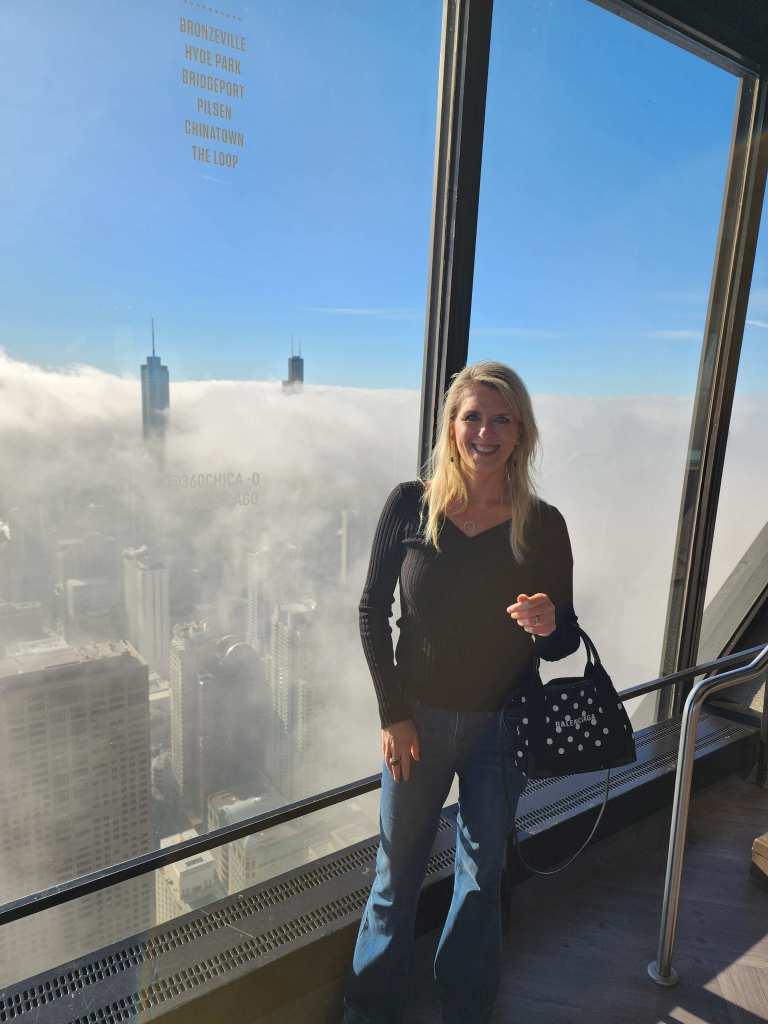
Rising above North Michigan Avenue, the 360 Chicago Observation Deck offers an awesome perspective from the top of the historic John Hancock Center. Completed in 1969, the Hancock Tower was a feat of engineering, famous for its X-braced exterior that allowed it to soar skyward while withstanding Chicago’s powerful winds. We started our journey through a museum that explained the history of the John Hancock Building and the city. I really enjoyed the 2 or 3-minute historical movie clip that starts visitors on the way. Unfortunately, it is quite noisy in this area, so it can be overwhelming for some. The museum then takes you through a description of Chicago’s neighborhoods and other Chicago cultural moments. After we finished exploring this area, we were whisked to the top the 94th floor, where wraparound windows reveal stunning views of Lake Michigan, the Magnificent Mile, and up to four states on a clear day.
But it was not a clear day. In fact, there was no visibility. We knew this before we ascended though, and the employees had even offered to change our reservations, but that was the time we had allocated to see 360 Chicago, so we went for it. We were rewarded! We had the entire place to ourselves, except for the workers, and wandered around looking at the various elements of the floor when sun started to peak through the clouds. We watched as the fog lifted revealing the city and lake around us. It was magical and truly a once-in-a-lifetime experience. I doubt we will ever get that lucky again. After about 15 minutes of us having that view all to ourselves, people started coming up and the “no visibility” sign was taken down. Our wait was well worth it.
Accessibility thoughts:
Like the Sears Tower, we had no accessibility issues. Finding the wheelchair entrance was a little tricky, but once we discovered that everything else was smooth, literally. A series of ramps accompanies stairs around the floor and the elevator is large enough to easily accommodate a wheelchair/mobility scooter user and others.
Field Museum
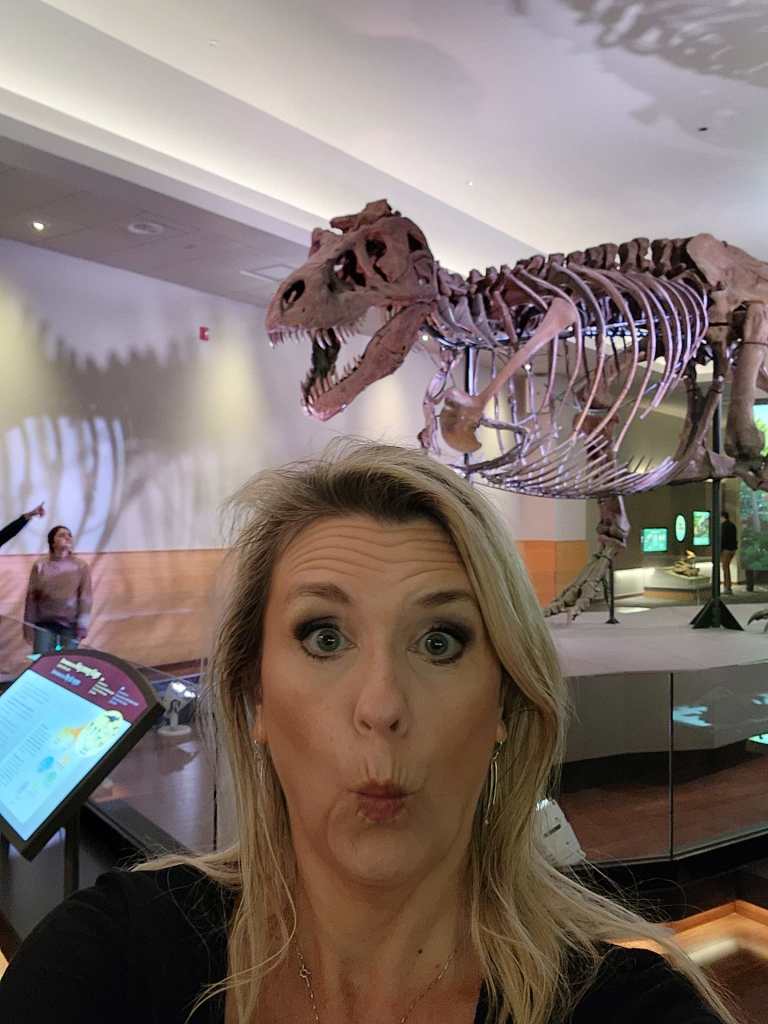
The Chicago Field Museum is filled with Egyptian artifacts, dinosaur skeletons, gems, meteorites, and cultural items and taxidermized animals from all over the world. The minute I enter the main gallery of this neo-classical-looking gem, I see dinosaur skeletons and majestic elephants. Upstairs, my old friend, Sue (who happens to be a Tyrannosaurus Rex), smiles at me with her (still-sharp!) teeth. I love the ancient Egyptian exhibit. Chicago’s university has a great Egyptology department, so the museum has some particularly good finds. Since I was a child, I have been fascinated by a cat mummy on display there. I was happy though to learn that most of the exhibition is undergoing renovation, which was greatly needed. In the future, it will be part of the Africa exhibit, and the museum is working with Egyptian curators to make sure the stories are told well, any necessary artifacts are repatriated, and that the human remains (mummies) selected for display will have care taken to portray them respectfully and appropriately.
The museum’s heritage starts with the 1893 World’s Fair and donations made by prominent citizens who wanted to see a permanent exposition to educate and bring honor to the city. Marshall Field, the retail store magnate, donated a million dollars to start the museum. With additional funds from industrial heavyweights, such as George Pullman and Harlow Higinbotham, the establishment of the museum was assured. Collections were purchased while some were artifacts that had been on display at the World’s Fair. Over a hundred years later, the museum continues to collect items designed to educate and delight. Leave at least a couple of hours to explore, because there is a lot to see. If you have children, they will probably find the sights quite exciting as the museum appeals to all ages.
Accessibility thoughts:
The Field Museum continues to put care and thought into designing exhibits in a manner where people of varying abilities can experience and enjoy them. The museum has elevators centrally located, making seeing exhibits upstairs and downstairs a shorter distance. The exhibits themselves are designed with wide passages to allow wheelchair users to go through. The museum prides itself on accessibility, so those needing assistance should inquire about what they offer.
I’ve written about the Field Museum before, see my blog for more details: https://roaminghistorian.com/2024/08/11/chicago-field-museum/
Art Institute of Chicago
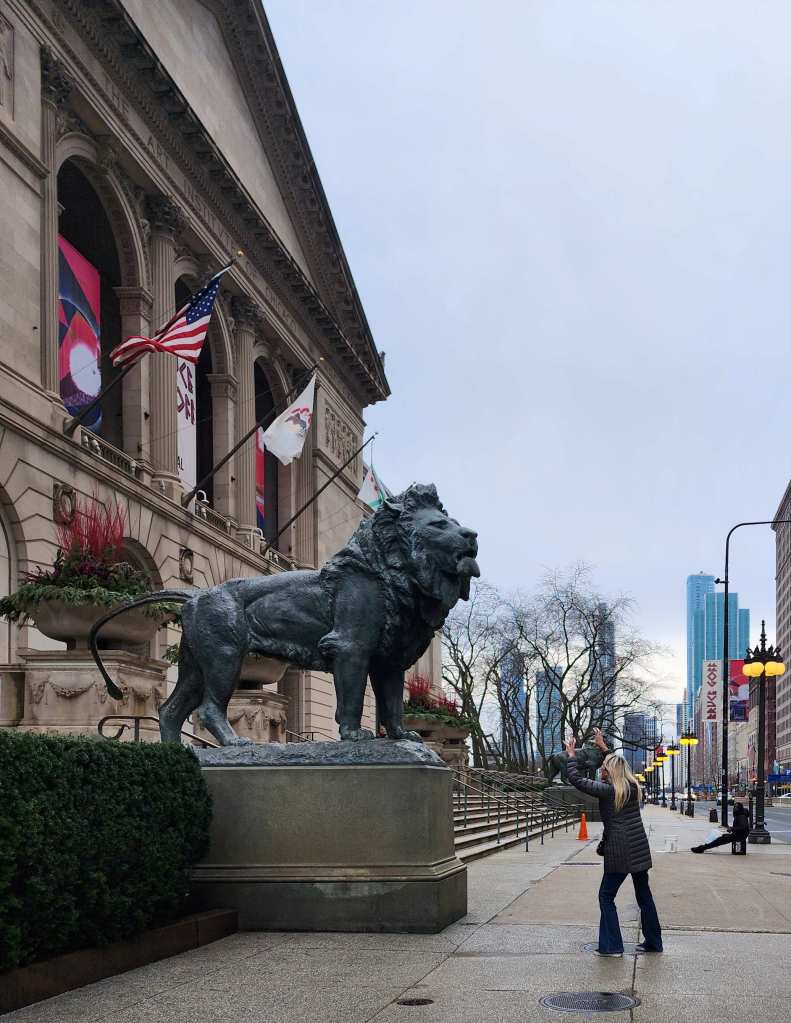
Tracing its roots back to the 1893 World’s Fair, the Art Institute of Chicago is an impressive artifact in itself. See me talking about its history here: https://youtu.be/7aKb3xRBeAo Founded in 1879 and housed in its grand Beaux-Arts building since 1893, the Art Institute of Chicago is one of the oldest and most celebrated art museums in the United States; it is a cornerstone of the city’s cultural life. Instantly recognizable by its iconic bronze lions guarding the entrance on Michigan Avenue, the museum’s roots trace back to Chicago’s ambition to become a world-class cultural capital after the Great Fire. Inside, visitors can wander through an extraordinary collection that spans thousands of years, from ancient artifacts to modern masterpieces, including world-famous works like Grant Wood’s American Gothic, Van Gogh’s The Bedroom, and an unrivaled collection of Impressionist paintings outside of Paris. There are fabulous stained-glass pieces by Louis Comfort Tiffany and Marc Chagall. When the 1894 Chicago Stock Exchange building, designed by Louis Sullivan and his partner, was demolished, sections of the Trading Room were preserved and used in a renovation of the building. Visitors can see the trading room as it would have looked in what I found to be a very interesting exhibit (of course, I am a former stockbroker). The Art Institute offers an experience that is both artistically and historically rich and I was glad it was an option.
Accessibility thoughts:
The building is accessible, but we found their structure lacking. There were three doors to enter; only one had a wheelchair accessible button. We entered only for a guard to tell us we had to leave and go through the door with a metal detector. I pointed out that there was no way for a wheelchair user to enter alone since there was no door-opening mechanism, but she said, “there is usually someone there to help.” Except there wasn’t that day. And after telling Jon he had to go out and back in, she hadn’t even tried to help or get someone to help.
The museum is in need of better way finding. I spend a lot of time in art institutes and the best have rooms/halls clearly numbered (so you can correspond to the map) and have a list of what main artists you will see within each gallery. The setup of their galleries, especially in the separate Renaissance and European galleries, didn’t make sense at times. We found ramps and elevators confusing, too. Many of the gallery workers did not know which artists were in the rooms they were watching. The basement rooms were very difficult, as once we descended on one elevator, we could not find a connection to the rest of the exhibit. We went upstairs and were told we had to travel through the entire museum to the back (we were at the front) and take the elevator there. We gave up at that point (even though it meant missing out on the Egyptian exhibit), as we had just come from the back and didn’t want to retrace our steps. I think they would be well served to work on signage. They may not be able to easily add ramps or elevators, but clear signage and maps could help those with mobility problems assess distance for what they want to see and not go back and forth.
How much can you save?
Starting at $142 for adults, the Chicago CityPASS®️ can save you up to 49%. The Shedd Aquarium (with a 4D experience) costs $54.95 admission, Skydeck Chicago (with expedited entry and the glass Ledge platform) costs $60.50, the Shoreline Sightseeing Architecture River tour costs $48.77, the Field Museum (with standard add-on exhibitions) costs $43, the 360 Chicago Observation Deck (with fast pass) is $59, Griffin Museum of Science and Industry costs $37.95, the Art Institute of Chicago is $40, and the Adler Planetarium (with two sky shows) costs $40. To give you an idea of savings, the Shedd Aquarium and the Skydeck Chicago costs $115.45…for $26.55 more you get access to three additional attractions (and each of those alone is worth more than that)!!!
Details and the CityPASS®️ app
- Reservations are required at: Skydeck Chicago, Shoreline Sightseeing Architecture River Tour, 360 CHICAGO Observation Deck, and Griffin Museum of Science and Industry. Reservations are recommended at the Shedd Aquarium.
- CityPASS®️ app: Once you purchase your tickets, be sure to use the “My CityPASS®️” app to plan your attraction visits and make reservations (if required). I loved this app; it kept my tickets easily accessible and making reservations was a breeze. In fact, when I arrived at the Shedd Aquarium, there was a sign saying that tickets were “sold out” for the day but since I had the CityPASS®️ I just made reservations while standing in line and strolled right through the door. You’ll find details about each attraction, including offers, maps, times, etc. It was nice to have one place to go for each attraction to check if there were special events occurring, hours of operation, discounts, etc.. The app also has a FAQ section which is especially helpful.
- Validity: Tickets are valid for a 9-day period starting on and including the first day you visit an attraction or have a reservation. For example, if you visit your first attraction on the 10th day of the month, your last day of validity would be the 18th day of the month.
- Expiration: You have one year from the date of purchase to start using your tickets.
- Refund policy: CityPASS®️ offers a generous refund policy, which is also a nice benefit. https://support.citypass.com/hc/en-us/articles/21853025422484-What-is-your-refund-policy
If you’re planning on sightseeing Chicago’s top attractions, you should definitely see if the CityPASS®️ makes sense for you. If it does, links are below. Happy travels!
Purchase tickets at CityPASS®️ Official Site: https://www.citypass.com/
CityPASS®️ FAQ and Chicago details: https://www.citypass.com/chicago
Some YouTube Clips I made:
Shedd Aquarium (dolphins and whales) https://youtu.be/rkou3ExokmU
Shedd Aquarium (sharks): https://youtu.be/XSOO4gjUCvk
Field Museum (dinosaurs): https://youtu.be/mj7WZaovqMs
Art Institute (trading room and Chagall): https://youtu.be/lOffqNUnW38
More Chicago tourism links
Top Chicago attractions through Viator: https://www.viator.com/Chicago/d673-ttd?pid=P00161535&mcid=42383&medium=link&medium_version=selector (Chicago)
Chicago River tour: https://www.viator.com/tours/Chicago/Chicago-River-Architecture-Tour/d673-76126P1?pid=P00161535&mcid=42383&medium=link&medium_version=selector
Chicago Field Museum All Access Pass https://www.viator.com/tours/Chicago/Field-Museum-of-Natural-History-All-Access-Pass/d673-38510P3?pid=P00161535&mcid=42383&medium=link&medium_version=selector
Sky deck Willis Tower: https://www.viator.com/tours/Chicago/Skydeck-Chicago-Admission/d673-5671SKYDECK?pid=P00161535&mcid=42383&medium=link&medium_version=selector
Chicago crime and mob bus tour: https://www.viator.com/tours/Chicago/360-Chicago-formerly-John-Hancock-Observatory-Admission/d673-5651JHO?pid=P00161535&mcid=42383&medium=link&medium_version=selector
Chicago hop on hop off bus tour: https://www.viator.com/tours/Chicago/360-Chicago-formerly-John-Hancock-Observatory-Admission/d673-5651JHO?pid=P00161535&mcid=42383&medium=link&medium_version=selector
Amy French, Ph.D., is the voice behind Roaming Historian. A professional historian and seasoned traveler, she shares stories that blend history and travel to give readers a deeper understanding of the places they explore.
Traveling soon? You will love our tour partners at LivTours, Tour Guy, and Viator. Check them out:
LivTours (semi-private/private tours): https://livtours.com?af_code=E1DDN61
**You can save 10% on LivTours tours with the code AMYRH10 (good on two or more tours)
TourGuy (small group/private tours): https://tidd.ly/3J78sNi
Viator (small to medium size groups/private): https://www.viator.com/?pid=P00161535&mcid=42383&medium=link&medium_version=selector
Protect your vacation with Travel Insurance dot com. This awesome travel site provides quotes from numerous travel insurance agencies and allows you to purchase them with no added increase to you: https://www.travelinsurance.com/?utm_source=pap&a_aid=65590b3a60c44
With industry leaders in tours, travel insurance, hotels, vacation rentals, flights, cruises, and trip planning, explore the world with our curated list of affiliate links on our Travel Planning page. Book travel insurance, tours, hotels, and more: https://roaminghistorian.com/travel-planning/
Disclosure: Roaming Historian may derive revenue from affiliate links and other sources, which helps offset the costs of bringing you the information we do. The blogs and reviews posted on this website are of our own opinion though.
Chicago City Pass: https://www.viator.com/tours/Chicago/Chicago-CityPass/d673-2640CHI_TR?pid=P00161535&mcid=42383&medium=link&medium_version=selector
 Roaming Historian